

GRILINCTUS - BM® Syrup / Tablets
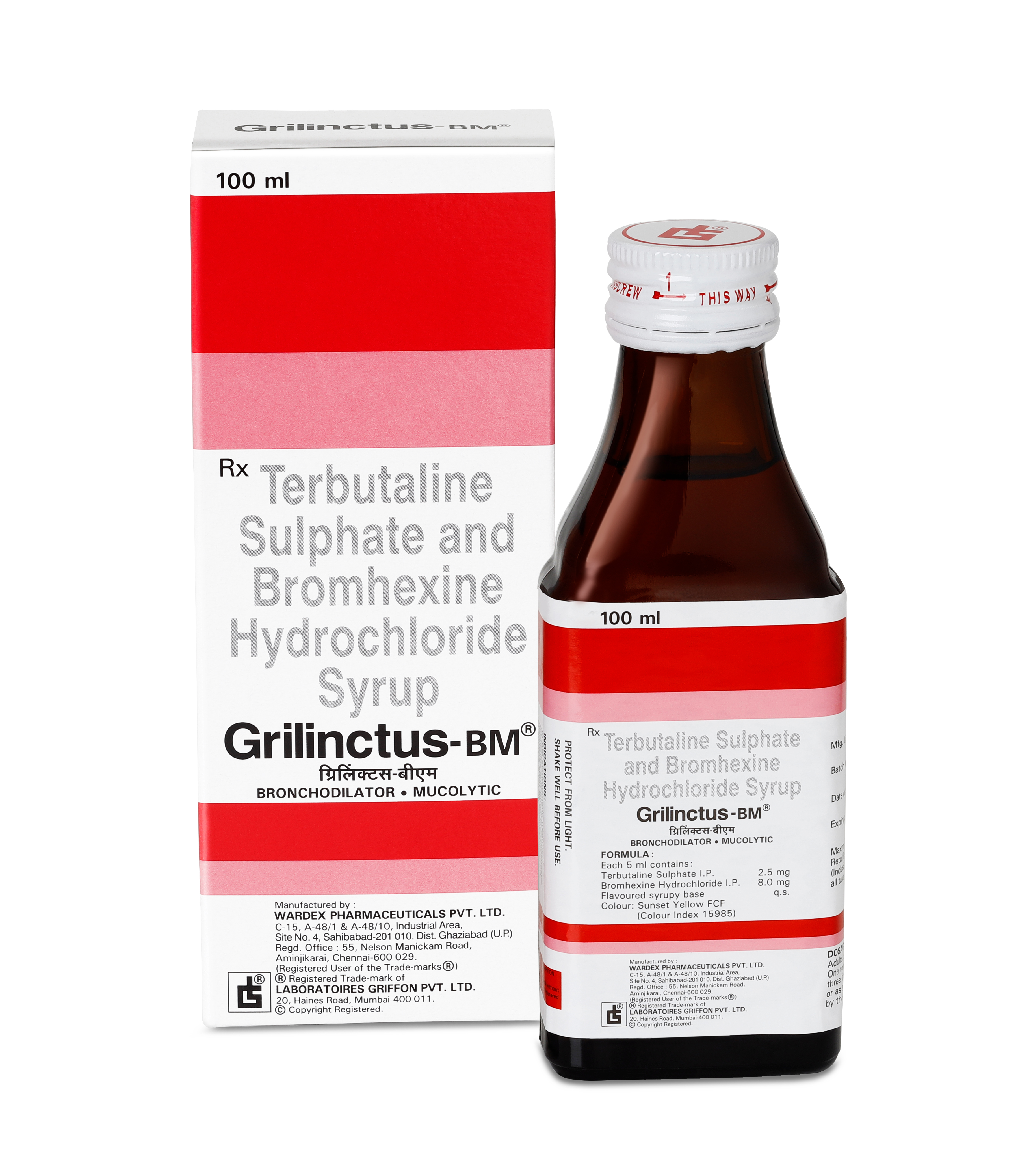
Composition:
Each 5 ml contains:
- Terbutaline Sulphate I.P. .....................................……………. 2.5 mg
- Bromhexine Hydrochloride I.P. ..........................…………. 8.0 mg
- Flavoured Syrup Base .......................................………..…..… q.s.
- Colour: Sunset Yellow FCF (Colour Index 15985)
GRILINCTUS - BM® Tablets
Each uncoated tablet contains:
- Terbutaline Sulphate I.P. ....................................…………….… 2.5 mg
- Bromhexine Hydrochloride I.P. .........................……………. 8.0 mg
- Excipients..........................................................…………………………… q.s
Description
- In various disorders such as acute and chronic bronchitis and other bronchospastic disorders such as eosinophilia, there is a spasm of the bronchial muscles and irritation of the bronchial mucus membrane, leading to breathlessness and cough. In the symptomatic management of these disorders, the mainstay of treatment consists of bronchodilators and mucolytic agents. Bronchodilators, by their spasmolytic action, relieve bronchoconstriction, thus relieving patients from troublesome breathlessness, while the mucolytic agent facilitates expulsion of the accumulated sputum by reducing its viscosity and stickiness.
- Terbutaline is a selective 2 adrenergic agonist used as a bronchodilator for reversible airway obstruction. It is variably absorbed from the gastrointestinal tract and is subject to fairly extensive first-pass metabolism in the liver. It is excreted in the urine partly as metabolites and partly as unchanged terbutaline.
- Bromhexine is a synthetic benzylamine derivative of vasicine, an alkaloid derived from the plant Adhatoda vasica. It is a mucolytic agent, rendering the sputum less viscous, thereby facilitating easy expulsion from the respiratory tract.
- Bromhexine is rapidly absorbed from the gastrointestinal tract and about 85% to 90% of a dose is excreted in the urine mainly as metabolites. Bromhexine produces a rarefaction and fragmentation of mucopolysaccharide fibers in the sputum. By this action, it reduces the viscosity of the sputum and hence is considered as the drug of choice in conditions associated with productive cough.
Indications
- In the management of productive cough associated with bronchial asthma, acute and chronic bronchitis, and other bronchopulmonary disorders where bronchospasm, mucous plugging, and problems of expectoration co-exist.