

GLYCIPHAGE SR® Tablets
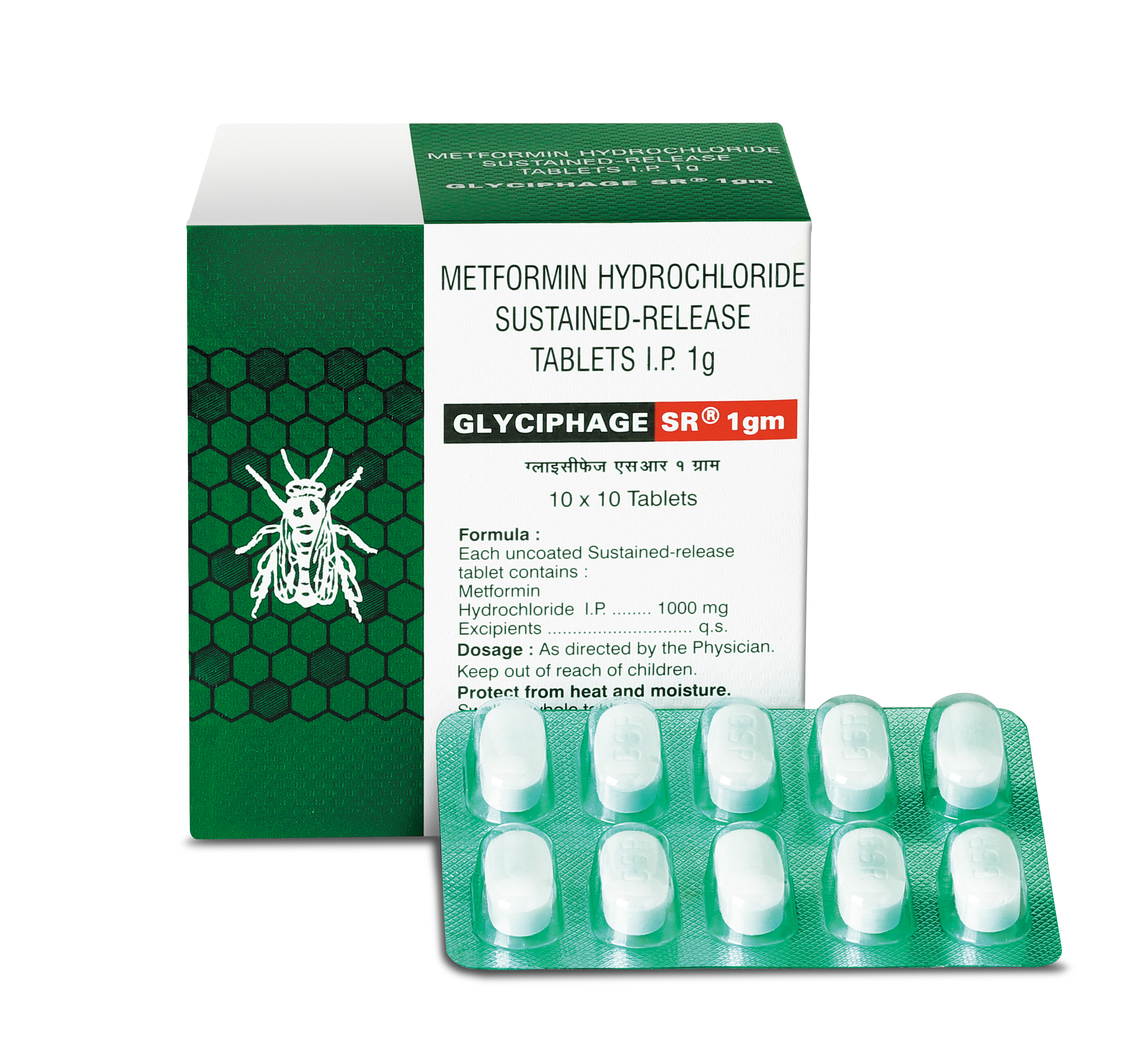
Composition:
GLYCIPHAGE SR® 500:
Each uncoated sustained-release tablet contains:
- Metformin Hydrochloride I.P. ……………………………………………………….. 500 mg
- Excipients.............................…............................................................…………. q.s.
GLYCIPHAGE SR® 850:
Each uncoated tablet contains:
- Metformin Hydrochloride I.P. ………………………………………………………… 850 mg
- Excipients.................................…................................................................….. q.s.
GLYCIPHAGE SR® 1 gm:
Each uncoated tablet contains:
- Metformin Hydrochloride I.P. ………………………………………………………… 1000 mg
- Excipients..............................….................................................................……. q.s.
Description
- For better patient compliance, Metformin is formulated in sustained-release form as GLYCIPHAGE® SR Tablets. GLYCIPHAGE® SR comprises of a dual hydrophilic polymer matrix system. On administration, fluid from the gastrointestinal (GI) tract enters the tablet, causing the polymers to hydrate and swell. Drug is released slowly from the dosage form by the process of diffusion that is essentially independent of pH. The biologically inert components of the tablet are eliminated in the feces as a soft, hydrated mass.
- The sustained-release formulation GLYCIPHAGE SR was developed to provide a once-daily dosage regimen thereby offering simplicity of dosing, the potential for improved compliance, and consequently improved glycaemic control.
Indications
- Monotherapy for adults (above 17 yrs.) with Type 2 Diabetes Mellitus, where regulated diet, weight control and exercise have failed to control blood glucose levels.
- GLYCIPHAGE® SR is especially useful if the patient is obese, as it helps to normalise weight. However, there is no contraindication to the use of the drug in patients who are not overweight, as it helps to normalize weight and blood glucose levels rather than reduce it below normal.
- GLYCIPHAGE® SR may be added as a co-prescription with sulfonylureas, glitazones and/or insulin, where the later when given alone, fails to control hyperglycaemia.
- In IGT (Impaired Glucose Tolerance).
- In PCOS (Polycystic Ovary Syndrome).
- In essential hypertension.