
DIAVIT PLUS® Capsules
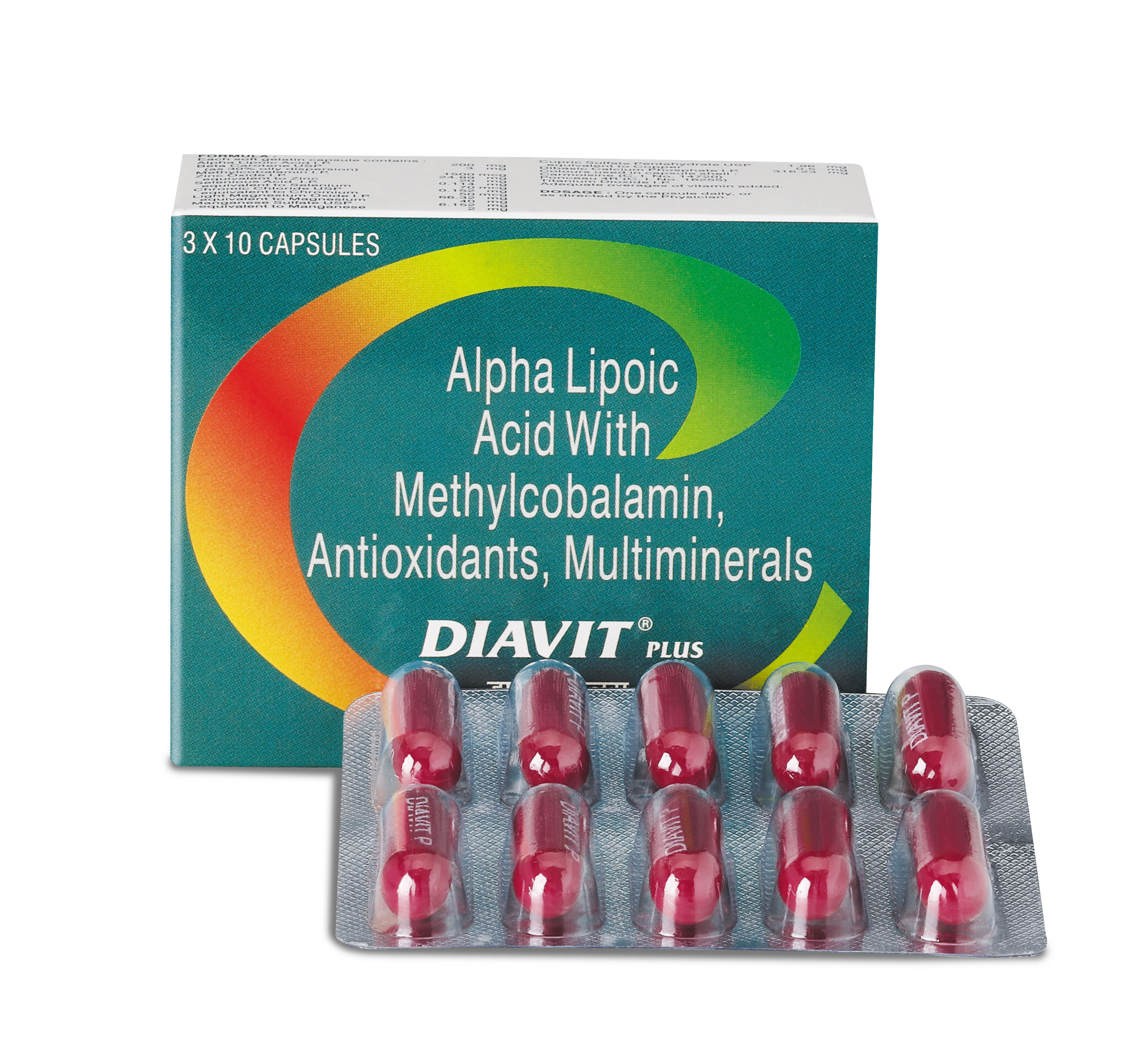
Composition:
DIAVIT PLUS®:
- Each soft gelatin capsule contains:
- Alpha lipoic acid …………………………………….…. 200 mg
- Beta carotene …………………………………..…….….. 3mg
- Methylcobalamin I.P. …………………………..…… 1500 mcg
Zinc Oxide I.P. 24.89 mg Equivalent to Zinc ……..………. 20mg- Selenious Acid U.S.P. …...……………….………………..……………….….…. 70 mcg
- Chromium chloride U.S.P. .…………………………………………….…….. 50 mcg
- Light Magnesium Oxide I.P. 66.32 mg Equivalent to Magnesium………..40 mg
- Manganese Sulphate U.S.P.6.152 mg Equivalent to Manganese.……….2 mg
- Cupric Sulphate U.S.P. 1.96 mg Equivalent to Copper ….………...0.5 mg
- Dibasic ca phosphate I.P. ………………………………………… 316.23 mg
- Excipients............................………………………….…………………..... q.s.
- Approved colours used in capsule shell: Carmoisine (C.I. No. 14720); Ponceau 4R (C.I. No. 16255)
Titanium Dioxide I.P. - Adequate overages of Vitamin added.
Description
- When blood sugar stays high for a long time, it can damage your blood vessels. This damage is partly caused by oxidative stress — a buildup of harmful molecules (called free radicals) that hurt your cells.
Your body has antioxidants that fight these free radicals. But in diabetes, the antioxidants can get used up too fast, leaving your body unprotected.
This leads to Microvascular Complications like Retinopathy, Nephropathy & Neuropathy –and Macrovascular Complications like Heart disease, Stroke etc.
Antioxidants help reduce oxidative stress, protecting blood vessels and slowing down or preventing complications. A healthy diet rich in vitamins and minerals — or supplements when needed — can help support your body’s natural defences. - DIAVIT PLUS® is a Multivitamin, Multi-mineral Antioxidant specially designed for diabetics. Each ingredient in DIAVIT PLUS® is selected judiciously keeping in mind the requirement of diabetics and is backed by sound scientific rationale.
- Alpha Lipoic Acid: Alpha Lipoic Acid is one of the most potent antioxidants that prevents lipid peroxidation and is a co-factor of key enzymes in glucose metabolism. It is called the "Universal antioxidant" as it is active in both the oxidized as well as reduced forms and is able to scavenge a greater number of free radicals than most antioxidants.
- It Decreases insulin resistance, Increases the sugar burning ability of insulin, & Increases ATP production. Regenerates other antioxidants like glutathione, vitamins C and E. Decreases the symptoms of diabetic complications, especially neuropathy.
It prevents diabetic late complications as it reduces free radicals and 'AGE-induced protein modifications, which seem to play a major role in the pathogenesis of nephropathy, retinopathy, and polyneuropathy. - Beta-carotene:
People with early or impaired diabetes often have lower levels of beta-carotene, a powerful antioxidant. Beta-carotene helps reduce oxidative stress, which can damage cells. It protects cell membranes by preventing lipid peroxidation (fat damage). It may help lower harmful LDL cholesterol and slow the development of atherosclerosis (narrowing of arteries). Supplementing with beta-carotene may support heart and blood vessel health in people with diabetes. - Methylcobalamin: Methylcobalamin is the active form of vitamin B12 that supports nerve regeneration and protects neurons without side effects. Methylcobalamin is associated with a clinical improvement in dysaesthesia, numbness, loss of sensation, and muscle cramps in diabetic peripheral neuropathy (DPN). An improvement in reflexes, vibration sense, lower motor neuron weakness and sensitivity to pain has also been observed.
- Zinc: Zinc is involved in virtually all aspects of insulin metabolism synthesis, secretion and utilization. There is a physical-chemical relationship between insulin and zinc. In the presence of zinc within the cell, insulin monomers assemble to a dimeric form for storage and secretion. Zinc plays a key role in insulin synthesis, storage, and secretion.
In diabetes, high blood sugar causes zinc loss, reducing insulin production and antioxidant defence. Low zinc levels may contribute to tissue damage in diabetic patients. - Selenium: Selenium is an antioxidant that supports glutathione peroxidase production. It may help lower blood glucose and protect against oxidative stress in diabetes.
- Chromium: Chromium enhances insulin action by improving glucose uptake into cells. Chromium enters the cell (independently of insulin) and binds to the protein chromodulin to form a complex. This complex binds to the insulin receptor, keeping it attached to insulin, thus increasing the entry of glucose into the cell. Chromium supplementation reduces hyperinsulinemia and improves glucose metabolism in both obese and Type 2 Diabetes patients. It also has a positive effect in IGT patients. It has been found to reduce total cholesterol and TG levels.
- Manganese: Manganese is an important co-factor in the key enzymes of glucose metabolism. A deficiency of manganese was found in diabetes.
- Magnesium: Deficiency of magnesium interrupts insulin secretion, increases insulin resistance and worsens glucose control in Type 2 Diabetes, Magnesium levels are significantly lowered in diabetics and lowest in those with severe retinopathy. Supplementation with magnesium leads to improved insulin production in elderly people with Type 2 Diabetes.
- Copper: Copper acts as an antioxidant. Unexplained neuropathy may be the result of a copper deficiency.
- Dibasic calcium phosphate: Calcium deficiency influences post-prandial glycaemia and insulin response. Calcium supplementation may optimize these processes. Dibasic calcium phosphate supplement may prevent oxygen transport impairment in diabetes.
Indications
- To meet the nutritional demands of diabetic patients.
- As an adjuvant in the management of the macrovascular and microvascular complications of diabetes.